
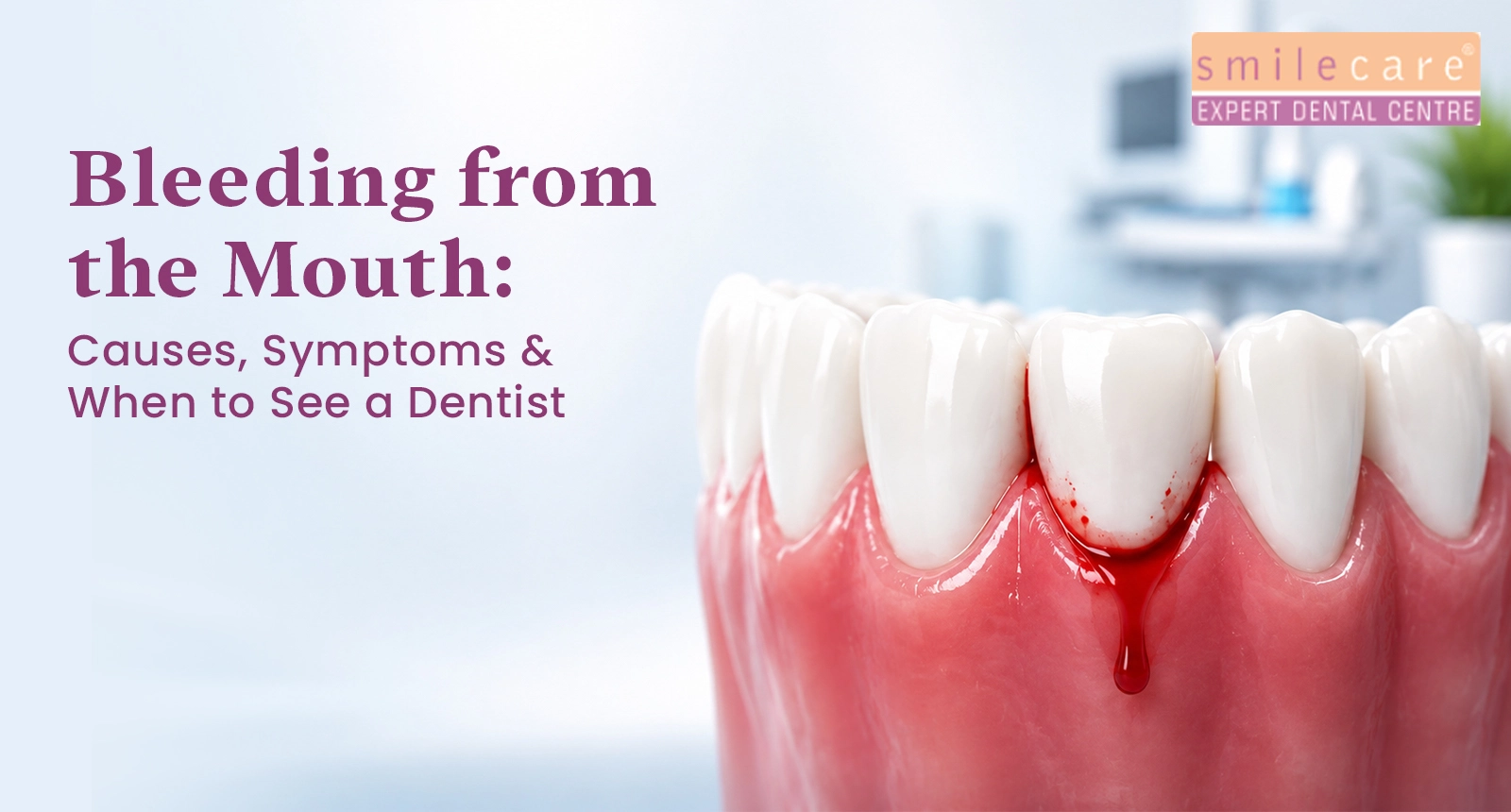
You’re brushing your teeth in the morning, you rinse your mouth, and suddenly notice something red in the sink.
Blood.
Your first reaction is probably, “Maybe I brushed a little too hard.”
So, you ignore it.
Then it happens again.
Maybe while flossing. Maybe while eating. Or perhaps you wake up one morning with a strange metallic taste in your mouth and realize there’s a little blood, but you have absolutely no idea where it came from.
That’s usually when the concern begins.
Seeing blood from your mouth can naturally feel alarming. But before assuming the worst, it’s important to understand that there are many possible explanations. Sometimes, the reason is as simple as irritated gums or accidentally biting the inside of your cheek. At other times, repeated bleeding can be a sign that your gums, teeth, or another part of your mouth needs professional attention.
The bigger question, therefore, isn’t simply how to stop the blood.
It’s finding out why it happened in the first place.
If you’ve been searching for a blood from mouth reason, this guide will help you understand some common causes, symptoms you should watch for, and when it’s time to see a dentist.
First, Is Bleeding from the Mouth Normal?
Not exactly.
There’s a difference between bleeding that happens because of an obvious injury and bleeding that keeps appearing without a clear explanation.
For example, if you accidentally bite your cheek while eating and see a small amount of blood, you know exactly what happened.
But if your gums bleed every morning while brushing?
Or you regularly notice blood coming from your mouth without knowing where it originated?
That deserves more attention.
Healthy gums generally shouldn’t bleed regularly. Occasional irritation can happen, but repeated mouth bleeding shouldn’t simply become something you learn to live with.
One of the biggest mistakes people make is normalizing it.
“My gums always bleed.”
“They’ve been doing that for years.”
“It stops after brushing, so it must be okay.”
But bleeding is a symptom. And when a symptom keeps returning, understanding its cause is important.
Where Is the Blood Actually Coming From?
Before asking why blood comes from the mouth, start with a simpler question:
Where is the blood coming from?
The mouth contains several areas that can bleed, including the gums, tongue, lips, inner cheeks, and tissues around the teeth.
Try to notice when the bleeding occurs.
Does it happen while brushing?
Does it happen when you floss between particular teeth?
Can you see a small cut on your tongue or cheek?
Do you have an ulcer?
Is there one specific section of the gum that repeatedly bleeds?
Or did you notice the blood after coughing or vomiting?
That last distinction is especially important because blood that appears to come from the mouth doesn’t necessarily originate in the mouth itself.
If blood appears after coughing or vomiting, the problem may require medical rather than routine dental evaluation.
1. Gum Inflammation: One of the Most Common Causes
Let’s start with one of the most common reasons people notice bleeding during brushing: inflamed gums.
Throughout the day, plaque continuously develops around your teeth and gumline. If it isn’t removed effectively, bacteria in the plaque can irritate the gums.
Over time, you may notice that your gums look red instead of their usual healthy appearance. They may become swollen, tender, or bleed while brushing and flossing.
The surprising part?
It may not hurt at all.
That’s why gum inflammation often gets ignored.
People assume that if there’s no pain, there can’t be a problem.
But early gum issues can exist without significant discomfort.
So, if your most common blood from mouth reason seems to be brushing, it may be worth getting your gums checked rather than simply switching toothbrushes and hoping the bleeding disappears.
2. You May Be Brushing Too Hard
Sometimes the problem isn’t that you aren’t cleaning enough.
It’s that you’re cleaning too aggressively.
Many people believe:
Harder brushing = cleaner teeth.
But that’s not how brushing works.
Aggressive scrubbing can irritate gum tissue and may contribute to gum recession and tooth sensitivity over time.
Take a look at your toothbrush.
Are the bristles completely spread out after only a few weeks?
Do you feel like you need to scrub your teeth to make them feel clean?
You may be applying too much pressure.
A soft-bristled toothbrush and gentle, controlled movements are usually enough for everyday cleaning.
Your teeth need thorough cleaning, not force.
3. You’ve Recently Started Flossing
You finally decided to start flossing regularly.
Great.
But now there’s blood.
Should you immediately stop?
Not necessarily.
If you haven’t cleaned between your teeth regularly before, your gums may already be inflamed and therefore bleed more easily when you begin flossing.
Incorrect flossing can also irritate.
The trick is to avoid snapping floss aggressively into the gumline.
Instead, guide it gently between the teeth and carefully clean along the sides of each tooth.
If bleeding continues despite consistent and gentle cleaning, however, it’s worth getting your gums evaluated.
Repeated mouth bleeding shouldn’t simply be blamed on flossing forever.
4. Gum Disease Could Be Developing
Occasional gum irritation and persistent gum bleeding are two different things.
When gum inflammation progresses, it may develop into more serious gum disease.
Apart from bleeding, you might notice symptoms such as:
- Red or swollen gums
- Persistent bad breath
- Gum tenderness
- Receding gums
- Changes around the gumline
- Increased tooth sensitivity
- Loose teeth in more advanced situations
The problem with gum disease is that it can progress gradually.
There may not be a dramatic moment where everything suddenly starts hurting.
Instead, small symptoms appear slowly.
A little bleeding today.
Bad breath that doesn’t seem to disappear.
Gums that look slightly different.
That’s why identifying the blood from mouth reason early can be important.
5. You Accidentally Bit Your Tongue or Cheek
You’re enjoying your meal and suddenly,
Ouch.
You’ve bitten the inside of your cheek.
And somehow, once you’ve bitten the spot once, you manage to bite the same area again.
Sound familiar?
Small injuries to the tongue, cheek, gums, or lips are another common reason for blood coming from the mouth.
Because the mouth has a rich blood supply, even a relatively small injury can sometimes produce more blood than you’d expect.
Minor injuries generally heal naturally.
However, if a wound repeatedly opens, doesn’t heal properly, becomes swollen, or continues bleeding, it should be examined.
6. Mouth Ulcers Can Sometimes Bleed
Mouth ulcers are already uncomfortable enough.
But if an ulcer keeps rubbing against a tooth or gets irritated while brushing or eating, it may occasionally bleed.
Spicy, crunchy, acidic, or sharp foods can make the irritation worse.
Most common mouth ulcers improve naturally.
But there’s an important rule to remember:
If you have a sore that persists for around two weeks or longer, keeps returning, changes appearance, becomes unusually large, or repeatedly bleeds, have it professionally evaluated.
Instead of continuously searching why blood comes from the mouth, getting the actual area examined gives you a much clearer answer.
7. A Sharp or Broken Tooth May Be Causing the Bleeding
Sometimes the bleeding isn’t coming from the tooth itself.
It’s coming from the tissue the tooth keeps irritating.
A chipped tooth, rough dental restoration, or sharp tooth edge may repeatedly rub against the tongue or inner cheek.
The tissue becomes irritated.
It begins healing.
Then the sharp edge rubs against it again.
And the cycle continues.
If blood coming from the mouth repeatedly seems to originate from the same location, check whether something is physically irritating that area.
A dentist can identify the source and recommend the appropriate treatment.
8. Braces or Dental Appliances May Be Irritating Your Mouth
If you’ve recently started wearing braces, retainers, dentures, or another dental appliance, your mouth may need some time to adjust.
Brackets can rub against cheeks.
Dentures that don’t fit properly can irritate gum tissue.
Retainers may occasionally create pressure or friction.
Small areas of irritation can sometimes result in minor mouth bleeding.
While some initial discomfort may occur with certain appliances, persistent wounds shouldn’t be ignored.
If the same area repeatedly becomes injured, speak to your dentist or orthodontist.
9. Food Stuck Between Teeth Can Irritate the Gums
Sometimes the explanation is surprisingly simple.
A piece of food gets trapped between two teeth.
It remains there.
The surrounding gum becomes irritated.
Then you brush or floss the area and suddenly notice blood.
If this happens occasionally, cleaning the area properly may solve the problem.
But if food repeatedly gets stuck in the same place and the gum keeps bleeding, mention it during your dental appointment.
Recurring food trapping can sometimes be associated with spacing, cavities, dental restorations, or other issues that need evaluation.
10. Dry Mouth Can Make Tissues More Sensitive
Saliva does much more than keep your mouth from feeling dry.
It lubricates oral tissues, helps wash away food particles, supports the mouth’s natural cleaning process, and contributes to overall oral comfort.
When saliva production is reduced, oral tissues may become dry and more vulnerable to irritation.
Dry mouth can occur because of dehydration, mouth breathing, certain medications, or various health-related factors.
If dryness is persistent and occurs alongside irritation, soreness, or blood from the mouth, talk to your dentist or doctor about it.
11. Dental Infections May Cause Bleeding
Sometimes bleeding appears alongside other symptoms.
Perhaps one area of your gum is swollen.
Maybe there’s tooth pain.
You notice a bad taste.
Or the area feels unusually tender.
Dental or gum infections can sometimes be associated with bleeding, swelling, pain, or discharge.
This isn’t something to repeatedly manage at home while waiting for it to disappear.
If bleeding occurs together with significant pain, swelling, fever, or other concerning symptoms, seek professional dental care promptly.
12. Certain Medicines Can Make Bleeding More Noticeable
Not every blood from mouth reason begins inside the mouth.
Certain medicines, particularly medications that affect blood clotting, can make bleeding easier or cause minor bleeding to appear more significant.
Some health conditions may also influence bleeding.
That’s why your dentist asks about your medical history and medications.
Those questions matter.
If you notice unusual bleeding after starting or changing a medicine, don’t stop taking prescribed medication by yourself.
Instead, speak to the healthcare professional who prescribed it and inform your dentist.
13. The Blood May Not Actually Be Coming From Your Mouth
This is an extremely important point.
If you see blood in your mouth, it’s easy to assume:
“My gums are bleeding.”
But sometimes, the source may be elsewhere.
For example, blood appearing after coughing or vomiting may require medical evaluation.
This is very different from seeing a tiny amount of blood while brushing.
If you’re coughing up blood, vomiting blood, experiencing heavy unexplained bleeding, having trouble breathing, feeling faint or dizzy, or experiencing significant weakness, seek urgent medical attention.
In situations like these, trying to determine why blood comes from the mouth through online information alone isn’t appropriate.
What Symptoms Should You Pay Attention To?
Blood itself is only one piece of the puzzle.
Pay attention to what’s happening alongside it.
For example, are your gums red or swollen?
Do you have persistent bad breath?
Is there tooth pain?
Do your gums appear to be pulling away from your teeth?
Is there an ulcer that isn’t healing?
Does one particular area repeatedly bleed?
Do you have swelling around the face or jaw?
Does the bleeding take unusually long to stop?
These details can help your dentist understand the possible cause much faster.
When Should You See a Dentist?
You don’t necessarily need to panic every time you see a tiny spot of blood.
But recurring or unexplained mouth bleeding deserves professional attention.
Consider seeing a dentist if:
- Your gums regularly bleed while brushing or flossing
- Bleeding continues despite gentle oral hygiene
- Your gums are swollen, painful, or tender
- You have persistent bad breath
- One area repeatedly bleeds
- You have a mouth sore that isn’t healing
- You notice loose teeth
- There’s dental pain or swelling
- You can’t identify where the bleeding is coming from
Early evaluation can help identify problems before they become more complicated.
What Can You Do to Reduce Mouth Bleeding?
The solution depends entirely on the cause.
If your gums are irritated because you brush aggressively, changing your technique may help.
If plaque and tartar are contributing to gum inflammation, professional dental cleaning and better home care may be needed.
If a sharp tooth is causing an injury, the tooth needs attention.
If an appliance is creating friction, it may require adjustment.
In everyday life, focus on gentle but consistent oral hygiene.
Brush twice daily with a soft-bristled toothbrush, clean between your teeth regularly, stay hydrated, and don’t ignore changes in your gums or other oral tissues.
Most importantly, avoid treating unexplained bleeding with random home remedies without knowing what’s causing it.
Stopping the blood temporarily and treating the actual cause are not the same thing.
Your Mouth Is Trying to Tell You Something
One of the easiest symptoms to normalize is gum bleeding.
You see blood.
You rinse.
It disappears.
So you move on.
Then it happens again tomorrow.
And again next week.
Eventually, you barely notice it.
But recurring blood from the mouth shouldn’t become part of your everyday routine.
Whether the blood from mouth reason is inflamed gums, aggressive brushing, an ulcer, a small injury, gum disease, or something completely unrelated to dental health, understanding the cause matters.
So, the next time you notice blood coming from your mouth, don’t immediately panic but don’t automatically ignore it either.
Pay attention to where it’s coming from.
Notice when it happens.
Look for accompanying symptoms.
And if it keeps returning, get it checked.
Because the answer to why blood comes from the mouth isn’t always complicated, but finding that answer early can make managing the problem much easier.
At Smilecare India, we believe good oral health begins with understanding the small signs your mouth gives you. Whether you’re experiencing recurring mouth bleeding, gum concerns, unexplained bleeding, or another dental issue, the right professional evaluation can help identify what’s happening and guide you toward appropriate care for a healthier, more comfortable, and more confident smile.
FAQs
1. What is the most common blood from mouth reason?
A common blood from mouth reason is gum inflammation, particularly when bleeding happens during brushing or flossing.
2. Why blood comes from mouth while brushing?
If you’re wondering why blood comes from mouth while brushing, possible reasons include inflamed gums, gum disease, or aggressive brushing.
3. Is mouth bleeding normal?
Occasional bleeding after a clear minor injury can happen, but recurring mouth bleeding shouldn’t be considered normal.
4. Why is blood coming from mouth without pain?
Blood coming from the mouth without pain may still originate from inflamed gums or another oral issue. Persistent unexplained bleeding should be evaluated.
5. When should I worry about blood from mouth?
Seek professional care for repeated, unexplained, or heavy bleeding. Coughing or vomiting blood requires medical evaluation rather than assuming it’s dental.
6. Can gum disease cause mouth bleeding?
Yes. Inflamed or diseased gums can bleed easily, particularly during brushing and flossing.

